
Plain cooked pasta lasts about 3 to 5 days in the fridge when it is cooled quickly and kept in an airtight container at 40 degrees Fahrenheit or below. That is the short answer to how long does cooked pasta last in the fridge, and it comes straight from USDA leftover storage guidance. But the number by itself does not tell you much.
What actually determines whether your leftover penne is fine on day 4 or risky on day 3 is how it was cooled, what it was mixed with, and how consistently your fridge holds its temperature.
In my experience, most people either overestimate how long pasta keeps because it still looks fine, or they toss perfectly good leftovers a day early out of caution. Neither approach is ideal. What I recommend instead is understanding the actual mechanics behind pasta storage, so you can make a confident call every time you open the fridge.
How Long Does Cooked Pasta Last in the Fridge
Plain cooked pasta with no sauce or added ingredients generally stays safe for 3 to 5 days when refrigerated properly. Pasta mixed with tomato sauce typically holds for about 3 to 4 days, while pasta combined with cream, meat, or seafood should be eaten within 2 to 3 days because those ingredients spoil faster on their own.
This range is not arbitrary. The United States Department of Agriculture recommends storing most cooked leftovers, including pasta, for no more than 3 to 4 days, and food safety educators describe the same window when discussing safe leftover storage.
Some sources extend plain pasta to 5 days since it contains no meat, dairy, or eggs, the ingredients most likely to spoil first. From a practical kitchen perspective, I treat day 4 as the point to plan on eating or freezing it, rather than pushing right to the edge of what is technically allowed.
Why Cooling and Refrigerator Temperature Matter So Much
The number of days pasta lasts is really a story about temperature. Bacteria that cause foodborne illness multiply fastest between 40 and 140 degrees Fahrenheit, a range food safety agencies call the danger zone. According to federal food safety guidance, perishable food should never sit at room temperature for more than 2 hours, or more than 1 hour if the room is above 90 degrees Fahrenheit, such as a hot kitchen in summer.
This is why cooling cooked pasta quickly matters. Leaving a full pot on the counter to cool completely before refrigerating can push it past that 2 hour mark, especially in a large batch that traps heat in the middle. One thing I always pay attention to is portioning food into smaller, shallow containers before it goes into the fridge, since smaller portions cool far faster than one large pot.
Your refrigerator setting matters just as much as your timing. A fridge running above 40 degrees Fahrenheit shortens how long anything lasts, pasta included. An inexpensive appliance thermometer is one of the more useful tools in a kitchen for this reason.
Cooked Pasta and the Bacillus Cereus Concern
Cooked pasta and rice carry a specific risk that is worth understanding on its own. Bacillus cereus is a bacteria that can survive cooking as a spore and then produce a heat stable toxin if the cooked food sits at room temperature for too long. Also read How to Thicken Soup Without Flour (7 Easy Methods).
Reheating pasta to a high temperature does not destroy this toxin once it has formed, which means the usual rule of “just heat it up hot enough” does not fully apply here.
The real safeguard is preventing the toxin from forming in the first place by cooling and refrigerating pasta promptly, not relying on reheating to fix a storage mistake after the fact.
Safety Versus Quality: An Important Distinction
It is worth being direct about something many articles gloss over. Cooked pasta can look, smell, and taste completely normal while still carrying food safety risk, because pathogens like Listeria are not something you can see or smell. At the same time, pasta that has simply dried out or turned a bit rubbery in the fridge is usually a quality issue rather than a safety one.
I do not recommend relying on appearance or smell alone to judge whether leftover pasta is safe, since the two issues do not always line up. If pasta has been stored for longer than the general guidance suggests, sat out too long before refrigeration, or shows any sliminess, mold, or a sour smell, the safest choice is to discard it rather than taste test it.
How to Store Cooked Pasta Properly
- Cool pasta quickly by draining it and spreading it in a shallow layer or dividing it into smaller portions rather than leaving it in one deep pot.
- Transfer pasta to the fridge within 2 hours of cooking, or within 1 hour if the kitchen is unusually warm.
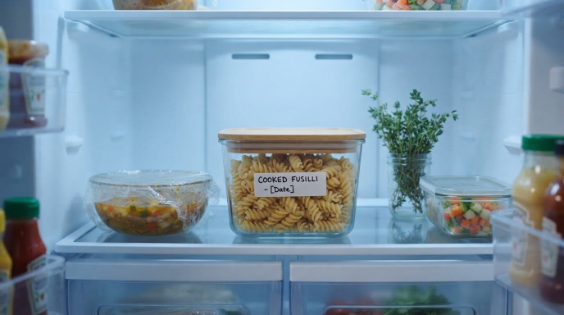
- Use an airtight container or a tightly sealed bag to prevent excess moisture loss and keep odors from other foods out.
- Keep your refrigerator at 40 degrees Fahrenheit or below, and check it occasionally with a thermometer.
- Store sauce separately from plain pasta when possible, since sauces containing dairy, meat, or seafood shorten the safe storage window.
- Label containers with the date cooked, which removes the guesswork later in the week.
- Reheat only the portion you plan to eat, since repeated reheating of the same batch increases risk.
Can You Freeze Cooked Pasta
Yes, cooked pasta freezes reasonably well, especially plain pasta without sauce. Frozen cooked pasta generally stays at its best quality for about 1 to 2 months, though it remains safe indefinitely if the freezer stays at 0 degrees Fahrenheit.
Texture does soften somewhat after thawing because pasta continues to absorb moisture, so I usually undercook pasta slightly if I already know it is headed for the freezer.
Pasta with cream based sauce tends to separate more after freezing than pasta with tomato sauce, which holds up noticeably better. Also read How to Fix Food That’s Too Salty (7 Kitchen Fixes).
Real Life Example
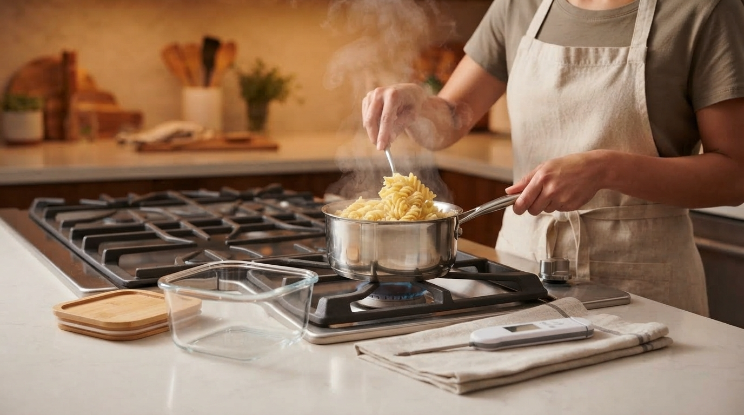
This is a practical kitchen scenario rather than a documented case study. Picture a Tuesday night where you cook a large pot of penne for the family, everyone eats, and a decent amount is left in the pot. If that pot sits on the stove while the kitchen gets cleaned up and dinner conversation runs long, an hour can pass without much notice. By the time it goes into the fridge, you may already be close to that 2 hour window.
A better routine looks like this. As soon as the meal is served, portion the remaining pasta into two or three shallow containers instead of leaving it in the cooking pot. Let it lose its initial steam for a few minutes, then seal and refrigerate it right away rather than waiting for it to reach room temperature first, since USDA guidance actually allows placing warm food directly into the fridge.
Three days later, when you pull a container out to reheat for lunch, check that it still smells normal and shows no sliminess, then reheat it until it is steaming hot throughout rather than just warm in the middle.
Cooked Pasta Storage At a Glance
| Storage Situation | Recommended Action | Safety Consideration | Quality Consideration |
| Plain cooked pasta, no sauce | Refrigerate 3 to 5 days | Low risk if cooled within 2 hours and kept at 40 F or below | Texture stays firmest in the first 3 days |
| Pasta with tomato sauce | Refrigerate 3 to 4 days | Sauce ingredients can shorten the safe window | Flavor holds up well, sauce may thin slightly |
| Pasta with cream or meat sauce | Refrigerate 2 to 3 days | Dairy and meat spoil faster than plain noodles | Sauce may separate on reheating |
| Pasta with seafood | Refrigerate 2 days | Seafood carries a shorter safe storage window | Best eaten within a day or two for texture |
| Pasta left out over 2 hours | Discard | Risk of Bacillus cereus toxin and other bacterial growth | Not applicable, food should not be kept |
| Pasta you want to keep longer | Freeze in an airtight container | Safe indefinitely at 0 F, best quality 1 to 2 months | Plain pasta freezes better than creamy sauces |
Frequently Asked Questions
How long does cooked pasta last in the fridge?
Plain cooked pasta generally lasts 3 to 5 days in the refrigerator when cooled promptly and stored in an airtight container at 40 degrees Fahrenheit or below. Pasta mixed with sauce, meat, or seafood should be eaten sooner, usually within 2 to 4 days.
Can I eat cooked pasta after several days?
If it has been refrigerated properly and it is still within the 3 to 5 day window for plain pasta, or the shorter window for pasta with added ingredients, it is generally fine. Past that window, the safest choice is to discard it even if it looks normal.
How should cooked pasta be stored?
Cool it quickly, portion it into shallow containers, seal it tightly, and refrigerate within 2 hours of cooking at a fridge temperature of 40 degrees Fahrenheit or below.
Can cooked pasta be frozen?
Yes. Cooked pasta, especially plain pasta, freezes well and keeps its best quality for about 1 to 2 months, remaining safe indefinitely if the freezer stays at 0 degrees Fahrenheit.
How long can cooked pasta sit out?
No more than 2 hours at normal room temperature, or 1 hour if the room is above 90 degrees Fahrenheit. Beyond that, bacteria can multiply to unsafe levels.
How do I reheat refrigerated pasta?
Reheat it until it is steaming hot throughout, ideally reaching an internal temperature of 165 degrees Fahrenheit, and only reheat the portion you intend to eat rather than the entire batch repeatedly.
Can you tell if cooked pasta has gone bad?
Sliminess, mold, or a sour smell are clear signs to discard it. However, pasta can carry food safety risk even when it looks and smells normal, so time and storage conditions matter as much as appearance.
Conclusion
The honest answer to how long does cooked pasta last in the fridge is 3 to 5 days for plain pasta, and a somewhat shorter 2 to 4 days once sauce, meat, or seafood enters the picture.
That range only holds true if the pasta was cooled within 2 hours of cooking, sealed in an airtight container, and kept in a refrigerator running at 40 degrees Fahrenheit or below.
Appearance and smell are useful checks but not reliable safety tests on their own, so when the timeline is unclear, freezing or discarding is always the safer call. Get the cooling and container step right, and the rest of the storage window takes care of itself.
For additional food safety background used in this guide, see NC State Extension’s leftover storage guidance.